I have recently been examining the histories of short line railroads. It is part of a hobby project. The short line railroads all operated in this region at one time or another. Unlike the massive railroads like the Santa Fe and Union Pacific with thousands of miles of track, most short lines are lucky if all their rail adds up to 20 miles.
One thing that kept coming to the forefront was a matter of personality. At one point or another, a short line would thrive and surmount almost any obstacle. The line may have had hard times previously, and may even have failed years afterward. Nonetheless, it experienced a time of success that stood out. The one thing that all of the short lines had in common during their best times was an uncommon excellence in leadership. Very often, it was the will and insight of one individual in a leadership position that guided a short line railroad through a period of its greatest success.
I am reminded fo what General John Pershing said about leadership. He stated: "A competent leader can get efficient service from poor troops, while on the contrary an incapable leader can demoralize the best of troops."
John Pershing was an amazing leader. In World War I, he not only led our Army, but managed to negotiate the political quagmire of dealing with our French and British allies. Pershing had been leading men for years before the World War. We can trust his estimation of the impact of leaders on their troops. The situation with short line railroads confirms the verity of General Pershing’s statement. A good leader makes a rinky-dink railroad thrive, and a bad leader can sink a giant railroad.
One such dynamic leader was George Clark of the Rahway Valley Railroad. Clark had experience in railroading in the West. He was brought in to run the Rahway Valley Railroad. Where leaders of big railroads sit atop several levels of bureaucracy, a small line improves with hands-on leadership. George Clark knew it. He was able to do every job on the railroad and understood every aspect from billing and paperwork to loading boxcars by hand. Clark was innovative and practical, He could see the rising competition from trucking and worked to mitigate its adverse effects on the Rahway Valley Railroad. The man had no pretensions about his small railroad, the competition ,and what it took to survive. Clark surrounded himself with good, reliable people. He was decisive and thoughtful.
When George Clark retired, his son took over his job. George Jr. had learned well and had the same traits as his father. Unfortunately, he died three years after assuming command of the Rahway Valley Railroad. No replacement could match Clark’s talented leadership. Today, the Rahway Valley Railroad is gone.
Another small railroad with good leadership was the Morristown and Erie. It stared with a character named Melnick whose railroad construction methods were haphazard, at best. The McEwan family took the reigns and everything improved. The McEwans were successful owners of paper mills in the region. Their business acumen set the Morristown and Erie Railroad in a profitable direction. The Morristown and Erie was able to survive against competition from trucking in the mid-20th century and the closing of plants that had been its customers. As with George Clark of the Rahway Valley railroad, the McEwans were up to all challenges.
In the 1960s, a new regime took over. Led by Andrew Cobb, it proved a disaster, Cobb and his crew started investign in non-transportation entities. They led the Morristown & Erie to bankruptcy. Fortunately ,the person charged with maintaining things under bankruptcy proved capable. The railroad was then acquired by Thomas Peterson. With Ben Friedland, he revived the Morristown and Erie. The small railroad thrives to this day, despite competition and changing markets. Good leadership accounts for a large part of it.
Here is a case where the experiences of short-line railroading confirm General Pershing’s insightful quote about leadership. Be it armies or trains or other businesses, leadership calls the tune. A good leader can make a rinky-dink operation succeed. History also shows that a bad leader can sink a first-class operation. Consider this carefully, because it is often the difference between success and collapse.
****
There is a booklet available about the history of the Rahway Valley Railroad. Here is the link: http://trainweb.org/rahwayvalley/Saga_of_a_Short_Line_by_John_J_McCoy.pdf
Monday, April 6, 2015

Tuesday, March 31, 2015
For Fans of O, O27 and S trains
Our CDs sold out, and now we have these DVDs. They contain all of the same great information plus more! Among the additional items are classic Lionel booklets. These include all of the following titles:
Train Layout Planning Book for Pop
Romance of Model Railroading with Lionel Trains
Scenic Effects for Model Railroads: Lionel Trains
Official Book of Model Railroading by Lionel
Fun with Lionel Model Railroading
Lionel Track Layouts
If you are running O, O27 or S trains, this DVD is a must. It has Lionel and American Flyer instruction manuals for trains and accessories, as well as guide to building layouts, making track plans, and a whole section of genuine information from real railroads.
http://thortrains.net/ads-sales/index.html
Train Layout Planning Book for Pop
Romance of Model Railroading with Lionel Trains
Scenic Effects for Model Railroads: Lionel Trains
Official Book of Model Railroading by Lionel
Fun with Lionel Model Railroading
Lionel Track Layouts
If you are running O, O27 or S trains, this DVD is a must. It has Lionel and American Flyer instruction manuals for trains and accessories, as well as guide to building layouts, making track plans, and a whole section of genuine information from real railroads.
http://thortrains.net/ads-sales/index.html
Thursday, March 26, 2015
Standard Toy Soldier Poses: Parade and Marching Men
My grandmother kept a shoebox full of toy soldiers in the living room. Boys played with them when they visited. There was various army men in different shades of olive drab, a couple of Indians, some cowboys and a few other odd pieces. My cousin was a very small boy at the time. He loved to open the box of soldiers and line up all the marching men. That would amuse him for hours.
 Those of us who spent seemingly endless hours marching the parade fields of Fort Dix and similar places know it all too well, Whether marching unarmed or under arms, it was part of military life. And for those of us who belong to veteran’s organizations now, the old marching skills get put to work on Memorial Day and July 4th and Veterans’ Day. Some groups march unarmed, some with rifles, and almost all have a few flags at the front.
 Marching has been used by military forces ever since someone discovered that it was the easiest way to move troops with the assurance they would all arrive together. The sharp turning maneuvers were useful for controlling units of troops in battle when men fought in close formations. A side benefit was that marching taught endurance and discipline.
 Part of marching was the manual of arms, a set of precise movements for both armed and unarmed drill. There were different ways to hold the rifle, to change direction, and to stand in formation. The same goes for cavalry. Marching, parade and the manual of arms were adapted to horse riders. Naturally, these appealed to the makers of toy soldiers. Sets of brightly-painted parade figures made their appearance. The old makers of flats designed everything from the ancient Egyptians on parade to the latest armies of the day. Parade poses are common in the metal figure sets. Collectors of the regiments of various armies favor them.
 Over time, armies went three ways when it came to uniforms. They had a combat uniform for fighting, a fatigue uniform for work details, and a parade uniform for drill and ceremonies. Of them all, the latter was considered formal and therefore was more ornate than the others. Miniatures of armies in parade dress
 has been an aspect of the toy soldier hobby that has a large following.
Of course, this was not limited to metal figures. Herald produced its sets of British Guardsmen. including the red-coated Coldstream Guards in Busbys and the Horse Guards in curaiss and shiny helmet. Britains made many sets of parade units in vinyl, including regular marchers and bands. Things went a different way with army men sold by the bag. A few men in marching poses might be included, but most of the figures were in action poses. A boy might need two or three bags to have enough marchers to fill a squad.
 ***
***
I remember when the Airfix HO / OO soldiers were first introduced to my neighborhood half a century ago. There were German infantry, an Allied Infantry Combat Group and a handful of others. Among them were Coldstream Guards in red and a Guards "Colour Party" in a pinkish color. We called them "parade men." Back then, they were less desirable than a case of Minesweepers and Dead Guys.
Of course, this was not limited to metal figures. Herald produced its sets of British Guardsmen. including the red-coated Coldstream Guards in Busbys and the Horse Guards in curaiss and shiny helmet. Britains made many sets of parade units in vinyl, including regular marchers and bands. Things went a different way with army men sold by the bag. A few men in marching poses might be included, but most of the figures were in action poses. A boy might need two or three bags to have enough marchers to fill a squad.
I remember when the Airfix HO / OO soldiers were first introduced to my neighborhood half a century ago. There were German infantry, an Allied Infantry Combat Group and a handful of others. Among them were Coldstream Guards in red and a Guards "Colour Party" in a pinkish color. We called them "parade men." Back then, they were less desirable than a case of Minesweepers and Dead Guys.
Wednesday, March 25, 2015
Murphy the Dog
(This post is not hobby related but it is such a funny story I thought I would share it here)
Up the country, my grandparents had a beagle named Murphy. He was a fun-loving dog. He could also be vindictive. For instance:
My brother and I had toy bazookas that shot a hollow little projectile. They did not do any damage or have much impact. We decided to use the dog for target practice, seeing as the hollow projectiles would not hurt him. The spring-loaded toys could hit a dog-sized target at about ten feet. Murphy did not like our bazookas. After an afternoon of being bazooka-ed, he had enough.
The dog slept in the garage in warm weather. There was a cool spot in there that he favored. Keep in mind that most homes were not air conditioned in those days. My grandmother even made a dog bed for him there. We left out bazookas in the garage with other toys. Next morning, the bazookas were ruined. The dog had ripped apart the cardboard tubes. Nothing else in the garage was disturbed. When we complained, we got in trouble for annoying the dog.
Another time, my cousins came up the country. Patty was about five years older than me, Jimmy was seven years older. They were throwing a football around. Being that much older than me, they were not going to include me in anything. Murphy was out there running loose. He wanted to play, too.
One of the cousins threw the ball and it hit the ground. Murphy pounced on it and got the end in his mouth. The football was half his size. They started yelling and chased him. Murphy outran the two of them and made a beeline for the woods. Patty and Jimmy lost him. It was as if that little dog struck a blow for both os us, because it amused me that they were so upset. The beagle made a fool of them. As far as I am concerned, Patty and jimmy deserved it. Irish justice!
Several years later, I was up in the woods in back of the house. I noticed something in a slight dip in the ground. Coming closer, there was something with a slightly oval shape, too regular to be natural. On closer inspection it turned out to be an utterly deflated, rotten, moldy football. The nearest houses were a quarter mile away, so there was only one way it got there. Murphy’s revenge!
Murphy was a great dog!
Up the country, my grandparents had a beagle named Murphy. He was a fun-loving dog. He could also be vindictive. For instance:
My brother and I had toy bazookas that shot a hollow little projectile. They did not do any damage or have much impact. We decided to use the dog for target practice, seeing as the hollow projectiles would not hurt him. The spring-loaded toys could hit a dog-sized target at about ten feet. Murphy did not like our bazookas. After an afternoon of being bazooka-ed, he had enough.
The dog slept in the garage in warm weather. There was a cool spot in there that he favored. Keep in mind that most homes were not air conditioned in those days. My grandmother even made a dog bed for him there. We left out bazookas in the garage with other toys. Next morning, the bazookas were ruined. The dog had ripped apart the cardboard tubes. Nothing else in the garage was disturbed. When we complained, we got in trouble for annoying the dog.
Another time, my cousins came up the country. Patty was about five years older than me, Jimmy was seven years older. They were throwing a football around. Being that much older than me, they were not going to include me in anything. Murphy was out there running loose. He wanted to play, too.
One of the cousins threw the ball and it hit the ground. Murphy pounced on it and got the end in his mouth. The football was half his size. They started yelling and chased him. Murphy outran the two of them and made a beeline for the woods. Patty and Jimmy lost him. It was as if that little dog struck a blow for both os us, because it amused me that they were so upset. The beagle made a fool of them. As far as I am concerned, Patty and jimmy deserved it. Irish justice!
Several years later, I was up in the woods in back of the house. I noticed something in a slight dip in the ground. Coming closer, there was something with a slightly oval shape, too regular to be natural. On closer inspection it turned out to be an utterly deflated, rotten, moldy football. The nearest houses were a quarter mile away, so there was only one way it got there. Murphy’s revenge!
Murphy was a great dog!
Tuesday, March 24, 2015
Standard toy Soldier Poses: the Dead Guy
Combat causes casualties. Infantrymen know this all too well. A fact of life in combat is the possibility of getting wounded or killed.
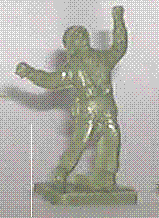

Herald was one of the first with a Dead guy. He is a soldier in 1950s kit with SLR rifle in hand. His free arm is raised and he is bent backwards. The intent it to make him look as if he had just caught a bullet.


Realism or a useless addition? The Dead guy is for diorama makers. Those playing with plastic or metal Army men have no real place for him.

Fixability and O Gauge Trains
Many new trains that are only four or five years old are sidelined indefinitely. Owners cannot get parts, Replacement boards are not available. Meanwhile, owners of original Marx, Postwar and MPC Lionel can take "lost causes" and have them running almost as good as new. Parts for the older trains are available. Why do the modern trains have so much trouble?
Perhaps a change in culture and technology tells part of the tale. There was a time when every neighborhood had a fix-it shop. The owner was a master at repairing appliances. He could fix a toaster, repair a lamp, or get the vacuum cleaner working correctly. People with broken items came to him. He had his various tools, electrical tape, all kinds of wire and cabinets with all kinds of screws and nuts and spare parts. There were no electronic boards to snap in or out in those days. Indeed, appliances were made very sturdy so that they would last. Part of their manufacture included making them fixable. People did not throw things away the way they do today.
Akin to the fix-it shop was the TV and Radio repair. The shop had all kinds of tools and testing equipment. It also had a stock of every kind of tube and component available at the time. A good technician could diagnose a problem in seconds and start to work on the repair. The broken TV, radio or record player would be back ot normal. Old TVs, radios and electrical gadgets were made to be repairable.
The cost of repair was far less than the cost to replace the entire unit, be it an electric egg beater or a console TV. These stores started to phase out in the late 70s. What hurt them were the new products with"Planned obsolescence" that could not eb repaired. They could only be thrown out and replaced.
Lionel Prewar, Postwar, MPC, Marx and American Flyer trains were designed in the era when things were fixable. In the Kughn era of Lionel, fixability went out as they sought cheaper ways to remake classic trains. The move from mechanical E-units to electronic ones was significant. Mechanical E units could be fixed. Electronic ones had to be disposed and replaced.
Cheap plastic gears and other cost-cutting measures also eroded repair-ability.
Having already heard of people whose treasured locomotives from several years ago have become shelf queens, I feel fairly certain this will become a much bigger problem in five years.
I predict that part of the problem will be solved by some electronic genius who can make a general set of replacement boards that are cheap and easy to install. They might not have all the features, but they will have enough to draw customers. You can be sure his boards will be stronger and made to last. If he backs that up with great customer service, a lot of shelf queens will become runners again.
Another side market will be those who find a way to repair and restore new trains. What with the emerging 3-D printers, parts will be easily replicated. Granted that most 3-d printing available to the public has been of plastic. New materials such as metals will be available in a few years.
As a nation and a culture, we need to return to the mindset that builds fixability into the things it makes. The disposable technology is not doing us any good. It is choking our landfills, depleting our bank accounts and feeding into insanity of a merchant-driven society. Making things that can be repaired and upgraded mauy not seem as profitable. In the end, it is the only reasonable way to proceed. With the coming of 3D printers and scanners, things will slide toward fixability as the technology becomes affordable. I believe that manufacturers will have no choice but to return to making repairable goods.
Spare parts will be as easy as downloading a CAD file online.
***
Despite all the fancy details, sounds and command control in new locomotives, they cannot match the reliability of the old trains. The proof of quality is obvious. 70-year-old electric trains are running smoothly while their modern counterparts are becoming shelf ornaments. The old trains ran and ran. Any breakdown could be remedied. Modern locomotives seem not to run as long. Repairs and placement parts are rare.
I find it amusing that the $1,000 locomotive sits on a shelf for lack of replacement parts, while the old Lionel #671 you can get off Ebay for under $100 will run almost as wel las the day it left the factory.
Perhaps a change in culture and technology tells part of the tale. There was a time when every neighborhood had a fix-it shop. The owner was a master at repairing appliances. He could fix a toaster, repair a lamp, or get the vacuum cleaner working correctly. People with broken items came to him. He had his various tools, electrical tape, all kinds of wire and cabinets with all kinds of screws and nuts and spare parts. There were no electronic boards to snap in or out in those days. Indeed, appliances were made very sturdy so that they would last. Part of their manufacture included making them fixable. People did not throw things away the way they do today.
Akin to the fix-it shop was the TV and Radio repair. The shop had all kinds of tools and testing equipment. It also had a stock of every kind of tube and component available at the time. A good technician could diagnose a problem in seconds and start to work on the repair. The broken TV, radio or record player would be back ot normal. Old TVs, radios and electrical gadgets were made to be repairable.
The cost of repair was far less than the cost to replace the entire unit, be it an electric egg beater or a console TV. These stores started to phase out in the late 70s. What hurt them were the new products with"Planned obsolescence" that could not eb repaired. They could only be thrown out and replaced.
Lionel Prewar, Postwar, MPC, Marx and American Flyer trains were designed in the era when things were fixable. In the Kughn era of Lionel, fixability went out as they sought cheaper ways to remake classic trains. The move from mechanical E-units to electronic ones was significant. Mechanical E units could be fixed. Electronic ones had to be disposed and replaced.
Cheap plastic gears and other cost-cutting measures also eroded repair-ability.
Having already heard of people whose treasured locomotives from several years ago have become shelf queens, I feel fairly certain this will become a much bigger problem in five years.
I predict that part of the problem will be solved by some electronic genius who can make a general set of replacement boards that are cheap and easy to install. They might not have all the features, but they will have enough to draw customers. You can be sure his boards will be stronger and made to last. If he backs that up with great customer service, a lot of shelf queens will become runners again.
Another side market will be those who find a way to repair and restore new trains. What with the emerging 3-D printers, parts will be easily replicated. Granted that most 3-d printing available to the public has been of plastic. New materials such as metals will be available in a few years.
As a nation and a culture, we need to return to the mindset that builds fixability into the things it makes. The disposable technology is not doing us any good. It is choking our landfills, depleting our bank accounts and feeding into insanity of a merchant-driven society. Making things that can be repaired and upgraded mauy not seem as profitable. In the end, it is the only reasonable way to proceed. With the coming of 3D printers and scanners, things will slide toward fixability as the technology becomes affordable. I believe that manufacturers will have no choice but to return to making repairable goods.
Spare parts will be as easy as downloading a CAD file online.
***
Despite all the fancy details, sounds and command control in new locomotives, they cannot match the reliability of the old trains. The proof of quality is obvious. 70-year-old electric trains are running smoothly while their modern counterparts are becoming shelf ornaments. The old trains ran and ran. Any breakdown could be remedied. Modern locomotives seem not to run as long. Repairs and placement parts are rare.
I find it amusing that the $1,000 locomotive sits on a shelf for lack of replacement parts, while the old Lionel #671 you can get off Ebay for under $100 will run almost as wel las the day it left the factory.
Standard Toy Soldier Poses: The BAR and :Light Machine Gun

Light machine guns found their place in World War I. Such weapons as the Lewis Gun, Chaucat and German MG08 were intended to give machine guns an offensive capability. They allowed troops to move forward and start firing almost immediately. Heavy machine guns were more defensive in nature. Moving them forward took time, several men, and required emplacing them all over again.


Subscribe to:
Posts (Atom)