More on Grant’s Battle Rules
As I implied in an earlier post, I really like Charles’ Grant’s World War II rules: “Battle: Practical Wargaming.” They are a good blend of realism and playability. The problem with them is that they are limited. Grant set the rules in the last year of World War II. As such, he included a small assortment of tanks, artillery and infantry options. Much was based on available models at the time.
This page has a variety of updates, additions and optional rules for playing Battle. You can choose whic h ones you like, adapt them as you see fit, or use them as a jumping-off point foir devising your own improvements.
I decided to use Grant’s rules as the basis for a trio of mini-wargames for model tanks and small scale soldiers. Following his lead, I was able to develop Speeds as well as Defense and Attack values for vehicles and weapons that he did not list. I also made some adjustments to “true up” the list with knowledge I had of armored vehicles.
Expanded charts: The original book gave charts for Defensive Value, Attack Value and Movement for a handful of vehicles. I have expanded that and made a few corrections along the way. These are included in three sets of “mini-rules” I compiled back in `05. I based these on Grant’s system.
Hans Und Panzer covers World War II circa 1943-1945 It covers many tanks and guns not included in the original Battle. Download a copy here: http://www.thortrains.net/milihistriot/muzzleblastanks.pdf
Hand Und Panzer Afrika Korps covers World War II circa 1939 - 1943 It includes several tanks and weapons used in the early part of the war. One typo: we listed the 45mm gun as German when it should have been Soviet. Get it here: http://www.thortrains.net/milihistriot/muzzleblastafrika.pdf
Krunch a Commie covers the Cold War from 1946 to about 1975. There may be some discrepancies. For instance, we list the Defensive Value of the Centurion at 18 based on an early model. The later model would be 19 or 20. I did not figure guided missiles like the TOW, Sagger or Shillelagh into the rules, nor was there any mention of reactive armor. I may have to work these out in the future along with larger HEAT weapons like the 106mm recoilless rifle. (I can tell you from experience that firing the 106 is a wonderful experience. Really cool!) Get it here: http://www.thortrains.net/milihistriot/muzzleblastcoldwar.pdf
Because of information I had, I have corrected a few of the armor values and such. These booklets can be used with Grant’s rules
***************
I use a different system for anti-tank gun hits. The front of a tank is at full Defensive Value. The sides are 2/3 this value, and the rear is ½. Though most tanks have ½ the armor on the sides, I take into account the skill of the drive ro minimize vulnerability. Otherwise, it would be Front: Full Defensive Value; Side: Half of Defensive Value; Rear, 1/3 Defensive value
When determining Defensive Value from sides or rear and you get an oddball number, round up.
Let’s be blunt: you may not agree with all of my Defense and Attack values. No problem. This is a hobby, not a religion or a science. Adapt and improvise as you see fit.
***********
If you want to take into account the skill and leadership of different armies, consider this
The US and Commonwealth armies are the baseline.
Soviet and Italian crews had less training both for troops and officers. However, Italian troops improved during the course of the North African campaign. Soviet troops were rushed through training. This is reflected in both morale and shooting.
Tanks and AT guns and morale:
Italians prior to July 1942 and Soviet crews fire at -1 on the first shot at a target.
Italians prior to July 1942 and Soviet troops get -1 on morale rolls.
Italian troops improved as they gained combat experience. Also, some units in North Africa were retrained by Rommel.
************
Optional horse cavalry rules (Cossacks, etc.) Cavalry moves 10" on road, 6" off road. Cavalry goes through woods at ½ cross-country speed.
***********
The morale rule I included in the mini games was a simple one. Frankly, I think Grant’s system is just as good. In his method, 10 is the base number. Points are added or subtracted and a single die is rolled. If the score adds up to more than 10, the unit is okay. If less, the unit stays in place .It must roll for morale the next turn. If it is nine or less, the unit retreats 1 full turn. It will continue to roll for morale at the beginning of each turn until it either routs off the board or scores 10 or more and operates according to orders. An officer can be sent the intercept the unit and help improve the morale score.
I have yet to work out a rule extending visibility to 60 inches. Such a rule would be very useful for fighting in the Desert (North Afrika, Egypt and Syria) as well as Cold War combat after 1960. In the latter case, improved optics and range finders make a difference. Again, there is also the issue of guided weapons that appeared in the 1970s. TOW and Shillelagh missiles come to mind. The trick is to keep it simple land practical. We do not want to confuse anyone. We have to be considerate.
Likewise. I do not feel confident that I can come up with values for the modern super-tanks such as the M1 Abrams, Challenger, T-90 and Leopard 2. The same goes for guided artillery and rocketry. This is why my games stop around 1975. Military technology has surpassed game play.
**********
Grant’s Additional Rules
In the additional Rules ( chapters 27 to 32, originally printed in Meccano magazine) are rules for terrain. Grant used graduated hills, somewhat like those of little wars, but contoured. Each contour was a rise of 50 feet. Going uphill reduced speed by ½, whether cross country or on road. Thus, going up a contour, a half move was plotted from the start point on the lower contour to the end point on the next one.
A point about 1 inch over the center of the top contour represents the hilltop. Troops on one side of the hill cannot see troops on the other side of the imaginary top unless one or the other crests the hill.
In Grant’s rules, movement through woods was 2/3 cross-country speed for Infantry. They were impassable to vehicles. There was no penalty for vehicles or men moving on roads through woods.
Rivers could only be crossed at fords and bridges. Smaller streams could be crossed at these rates: 2 moves for infantry and 4 moves for vehicles. The latter includes man-pushed artillery.
**********
Optional scenery / terrain rules:
Swamps are impassable except for amphibious vehicles. For LVTs, DUKWs, Schwimmwagens, etc, crossing swamps is at ½ cross country speed.
Lakes are impassable to all but amphibious vehicles. These can move at ½ cross-country speed.
Rivers: Amphibious vehicles cross rivers in one move. However, an optional thing is to roll for current. Determine direction of current before the game starts. Roll die for each vehicle. Each pip is 1 inch for small vehicles like schimmwagens and Weasels. It is ½ inches for larger things like DUKWs and LVTs. This is how far down-stream a vehicle will emerge from the river.
Optional bridge rules: The infrastructure in Europe and Asia was a hit-and- miss thing. This was especially true in Eastern Europe, China, Korea, Southeast Asia, Indonesia, New Guinea, and the Pacific islands. Not all bridges were created equally. Some could handle tanks, some could only handle lighter vehicles, and some could only handle horse carts and men. You can agree to rate bridges before the game:
Class 1: all vehicles
Class 2: medium tanks and lighter
Class 3: light tanks, half tracks and lighter
Class4: wheeled vehicles, armored cars and lighter
Class 5: men, horses, horse carts
A Class 1 would be obvious because of its size and strength. Some bridges should be obvious by their width. Some may not be as obvious. An optional rule is that the strength of Class 2, 3 and 4 might have to be revealed either by crossing them or by sending a scout to check them out first.
Once a vehicle enters a bridge, the bridge’s class is revealed. A scout takes 1/2 move to reveal the class of a bridge.
On crossing, a vehicle two or more classes higher than the bridge will damage it. Roll a die. 1, no damage. 2, 3, 4 moderate damage. The bridge’s class is lowered 1 level (For instance, a Class 3 becomes a Class 4 for the rest of the game). 5, 6 the bridge becomes impassable except by infantry. In the case of a 5 or 6, roll another die to see the fate of the vehicle: 5 or 6 means it falls in the collapse and is unusable for the rest of the game. 3,4 means it does not cross and must be immobile for 1 move. 1, 2 it crosses but must remain immobile for 1 move.
A vehicle 1 class higher than the bridge does damage thus: roll 1 die. On a 6, the bridge collapses. Roll as above for a collapsed bridge to see if the vehicle gets through. 4, 5, the vehicle cannot cross and the bridge is reduced 1 class. 2 or 3 the vehicle crosses but the bridge cannot take any other vehicle higher than its class without collapsing. On 1, the vehicle gets across without damage to the bridge or itself.
Class 5 bridges are always impassable by vehicles. There is no need to roll a die to determine their class. Class 5 bridges always look impassable to vehicles.
Artillery attacks on bridges: batteries of guns of 75mm or higher can fire to damage bridges. First, they must hit the bridge as per the regular artillery rules. If hit, a die is rolled. If the die roll is higher than the class of the bridge, another die is cast:
1, 2, 3: Bridge reduced 1 class.
4, 5: Bridge reduced 2 classes
6: bridge totally out.
If a bridge is hit several times and is reduced past 1, it is out.
**********
I still prefer the small-scale HO, OO and 1/100 vehicles by ROCO, Airfix, EKO and Roskopf. They are more fun that the 1/285 and 1/300 stuff. I got my start with ROCO and Airfix and tend to favor them. However, there are other makes out there offering good stuff. The soldiers by Caesar and Pegasus look nice. Matchbox made nice figures and models, too. Esci is okay, but in my opinion, not as good as Airfix.
Back then, I was unaware of Comet / Authenticast 1/108 scale recognition models of military vehicles. Nobody around us imported Roskopf models. We had what our hobby shops had. In our neighborhood, it was ROCO MiniTanks and Airfix soldiers and tank kits. At the time that Grant wrote his book, things were limited. ROCO had yet to release its German kubelwagen and schwimmwagen (German “jeeps”). Most of the available models and kits were of US and German vehicles. ROCO made two Postwar British tanks and only three World War II Soviet tanks. Most of the MiniTanks artillery was American. Airfix made a few British vehicles and guns.
As for soldiers, Airfix was the main source. The available sets for World War II were German infantry, Infantry Combat Group (British), 8th Army, Afrika Korps, US Marines, Russian Infantry, Japanese Infantry and Russian Infantry. The British Commandos had not yet been released. Our only other sources fo small soldiers were a few small ROCO sets and Giant, a Hong Kong manufacturer. Giant made crude US and German troops.
Since then, we have access to many more models from other makers. Roskopf became available. Matchbox, Fujimi, Hasegawa and Revell made vehicle kits. Matchbox, Revell, Esci, Pegasus and Caesar also made small-scale soldiers. That alone is cause to update the rules.
For info on the tiny tanks and soldiers, click here: http://www.thortrains.net/armymen/minimen/tinymen.html
Showing posts with label Airfix. Show all posts
Sunday, June 17, 2018
Additions, Updates and Improvement’s to Grant’s “Battle” Wargame Rules.
Labels:
Airfix,
armor,
Battle,
Charles Grant,
dice,
guns,
minitanks,
practical wargaming,
ROCO,
scenery,
tactics,
tanks,
terrain,
World War II
Friday, April 27, 2018
How Airfix Created a Hobby
![]() |
| Comet / Authenticast Panzer IV wit hbox |
![]() |
| Authenticast US Army |
There were a few companies making unpainted 20mm figures. These were close to HO size. Most were Civil War figures.
![]() |
| Size comparison: Authenticast M4 (left). Airfix Solider, ROCO M4 (right) |
![]() |
| Original Airfix Box, circa 1961 |
Airfix did not rest on its laurels. Following quickly after its first offerings were Civil War infantry and artillery, cowboys, wild Indians, the 8th Army, Afrika Korps and US Marines. ROCO also began expanding its line. Small scale military modeling and Airfix went mainstream, unlike earlier makers who purveyed onto to the niche elements among hobbies.
![]() |
| Airfix US Marines, original series |
![]() |
| ROCO M47 (first version) |
Indeed, Airfix was dynamic. Its next series of 1/76 figures were more detailed and covered a wider spread of history. Starting with the Russian Infantry, Japanese infantry and Arabs, Airfix’s figures made a large leap in realism. They also spread into other genre. Already established in World War II, the Wild West and the Civil War, Airfix expanded into World War I, Ancients, Medievals, the Napoleonic Wars and the American Revolution. Cheap, available figures were met enthusiastically by hobbyists.
![]() |
| 1/32 Man-at-arms |
Airfix also expanded its line of model kits to meet the needs of the toy soldiery. 1/76 scale military vehicle kits appealed to wargamers, military collectors and diorama makers. The original kits were very basic, but more vehicles were added. Most were World War II-era tanks and support vehicles. A few Cold War era vehicles were added, as well as vehicles for dioramas. Just as it pioneered the popularity of small-scale soldiers, so Airfix was the catalyst that launched 1/76 - 1/72 scale military vehicle kits. (This was followed in the 1970s by Matchbox, Fujimi, Hasegawa and other makers) Without Airfix, this may never have happened.
The next coup by the British hobby maker was to enter the 1/32 field. Their first set was make by pantographing their 1/76 Paratroopers into 54mm scale. They were nothing spectacular. Not content to try that again, the company issued all-new figures. The first set I saw was the British Commandos (29 figures for about $3.00). Soon after came the Russian and the German infantry. The detail and realism exceeded that of the toy manufacturers. Airfix took plastic army men to a whole new level.
![]() |
| Airfix 1.32 - 54mm British Commandos |
Several of the early HO / OO were upgraded soon after the introduction of 54mm figures. The German Infantry, Infantry Combat Group, US Marines, French Foreign Legion, 8th Army and Afrika Korps were replaced with more detailed figures. Several of the figures in each 1/76 set were copies of the new 54mm figures. These were supplemented with new poses. The 54mm sets themselves were mostly limited to 7 or 8 poses. Additional new poses were not added to them.
![]() |
| Airfix 1/32 -54mm Russian Infantry |
To its credit, Airfix kept making new sets. Modern soldiers entered the inventory. These were 1980s-style US (billed as NATO), British, West German and Soviet troops. There were also Sci-Fi figures, and 54mm US cavalry, Indians and Cowboys. Soon afterward, the introduction of new sets stopped. Airfix ran into hard times. Heller, the French model kit company, bought the molds. Lately, Hornby took over and moved production to India.
![]() |
| Airfix 1/32 - 54mm US Infantry |
Will Airfix ever start expanding its line again? That is hard to say. Its variety of models and figures is already vast. Airfix kicked off the small scale military hobby and the raised to bar on 1/32 scale figures. It launched the 1/76 - 1/72 military model genre. The company also produced a vast range of model aircraft, mostly in 1/72 scale, as well as ships and space models. Perhaps a new management might expand things, but that remains to be seen. There is a lot of competition in both the 1/76 and 1/32 scales. Even at that, Airfix is not likely to fade away. The are still the favorite of many. (That includes this author)
***********
A sad. part of the hobby is willingness of Chinese makers to copy or clone better figures. The most copied and cloned set of modern soldiers is the Tim Mee Vietnam-era troops. Following closely on its heels are the 54mm British paratroopers and German Infantry, who have been copied and cloned for over 20 years. In other genre, the Airfix Cowboys & Indians have been pillaged mercilessly by Chinese copyists. Clones and copies tend to be undersized, less detailed, and increasingly disproportionate.
Matchbox figures have also been cloned, mainly by toymaker Hing Fat. These are the US, German (Infantry and Afrika Korps) and British 8th Army sets. Atlantic Japanese were cloned, as well. As the cheap Chinese molds deteriorate ,figures get smaller and less detailed.
The fact is that serious hobbyists should avoid clones, if possible, and get figures made from the original molds. This assured detail and scale consistency. Leave clones to the kids.
*********
I have seen Airfix from its first sets in `61 or `62 to its current status. I like the product as much now as ever. When I need small-scale figures, that is where I look first. Through Airfix, I was introduced to small scale hobbying and historical wargaming. My original collections of figures and kits was lost over 30 years ago. (Of course, I wish I still had them.) Nonetheless, I have always liked their products.
One thing I miss are the old structure kits. Favorites were the knightly castle, Roman fort, Western cavalry fort and Foreign Legion fort. A smart hobbyist could take two or three of those kits and built a larger fort.
Favorite sets? Hard to say. I will always have a find spot for the original Infancy Combat Group and German Infantry, as these (along with the ROCO tanks) introduced me to a wonderful hobby. Thanks to the hobby, I made a lot of friends and had many good times.
*******************
I remember scrambling to the hobby shop with some change in my pocket, hoping to buy another ROCO tank or box of Airfix soldiers. There would be other boys like myself, looking at the display and trying to decide what to buy next. When you were a little boy in the early 1960s, 25¢ was good money and 50¢ was a major expenditure. We drove the hobby shop owner crazy as we tried to make that decision. Do I want another Sherman tank? A Panther? Or maybe a box of Airfix Marines. Decisions, decisions.*
![]() |
| AirfixInfantry Combat Group, circa 1961 |
Airfix and ROCO came out with new things every few months, so it seemed. My friends and I were thrilled to see each new set. The Sheriff of Nottingham set was a change because it included knights rather than Western figures, Civil War guys or 20th Century troops. We took releases of World War II figures in stride....Russian Infantry..Paratroopers...Commandos. The Romans and Ancient Britons were thrilling to see.
While we tried our hand at our made-up games with the small figures, we were not very good at it. A friend lent me a copy of Featherstone’s War Games. That changed everything. We could have little battles for World War II, the Civil War and Romans versus good guys . Half the fun was painting the model tanks. We could also paint faces and details on the Airfix figures.
One big side effect: friends. Lots of them. Building models together, painting figures, sharing modeling tricks. We liked to show off our stuff. People developed all sorts of tricks for making their small models more detailed. Things like “stretch sprue” antennae and handmade bundles made our models look better. That somehow improved the games.
Time certainly have changed. The old model-building and wargaming pals are scattered to the four winds. Adulthood brought other concerns that sent us hither and yon. I lost touch with them long ago.
( Perhaps that is why I could never get into the micro tanks at 1/285 and 1/300 scale. They were too small to make enhancements worth seeing. Kits from the 1/100 Roskopf to 1/76 Airfix were preferred because we could make them look great. )
![]() |
| 1/32 - 54mm Westerm Indian |
![]() |
| 1/32 - 54mm - US Cavalryman |
Sunday, April 15, 2018
The Airfix Difference
![]() |
| 54mm U.S. Infantry by Airfix These poses feel almost animated |
Airfix paved the way.
The first waves of plastic soldiers in the 50mm -60mm range were toy figures. The earlier ones by companies like Lido, TimMee, Crescent and Johillco were made as toys. Though some were realistic, the general run of plastic toy soldiers was hardly a scale miniature. The Louis Marx Company took things up a few notches with its 54mm lines. Some were very well detailed and quite realistic. Nonetheless, they were considered toy soldiers rather than military miniatures.
![]() |
| 54mm 8th Army |
Airfix raised the bar on plastic soldiers. Their 1/76 figures created a whole new field for the toy and model soldier hobby. Airfix pioneered the 1/76 scale in plastic and was the unchallenged leader and most prolific producer of them. The British company did it agin when it introduced its 1/32 scale sets of plastic soldiers. It had taken them from classic army men to quality hobby figures. These were a very different thing than the plastic toy soldiers by such firms as Lido, Tim Mee, Timpo and Crescent. The Airfix figures were scaled properly. had excellent detail and greater historical accuracy. Just as other companies decided to join the small,-scale figure market, so they eventually opted in to the 1/32 range as pioneered by Airfix.
![]() |
| 54mm British Commando - another good action pose |
The first set of Airfix 1/32 figures that I saw was the British Commandos. They were at Polk’s Hobby, somewhere around $3 a box of 29 figures. The set had seven poses. Sculpting was good. Soon afterward, I came across their German Infantry. Though the pose count was low, the sculpting and poses were solid. The same could be said when I acquired their set of Russian infantry. They were soon joined by the 8th Army and the Afrika Korps. The only complaint was the small number of poses in each set.
![]() |
| 54mm German Infantry, circa 1938-1942 |
Around this time, Airfix began updating several of its older 1/76 sets. The old Infantry Combat Group was replaced by WW2 British Infantry. The German Infantry, Afrika Korps, 8th Army and US Marines received an overhaul. In each set, several poses were copied from their new 1/32 sets. Other poses were added to the 1/76 scale sets.. I wondered why Airfix never added these poses to the 1/32 sets.
![]() |
| 54mm Italian soldier (stonato) and officer (cafone) |
![]() |
| British Paratroopers. Next to the Tim Mee "M16" infantry, one of the most cloned and copied sets of figures. |
![]() |
| Ghurka and British support infantryman. The British soldier was molded in hard plastic. |
![]() |
| 54mm German Paratroopers. One of the few sets with more than 8 poses |
***********
Crescent, Johillco (Hilco), Lone Star, Herald and Timpo were the British equivalents of Lido, Tim Mee and Marx. They were toymakers. Though some of the later Marx sets, such as the 54mm Marines, were high-quality sculpts, most of their output was toy figures. Airfix offered greater historical accuracy and sculpting. I was suitably impressed when I saw the British commandos in 54mm. They looked realistic and had some of the crispest detail I had even seen in a 54mm soft plastic soldier.
![]() |
| Well-detailed British infantry. A good example of Airfix's well-animated poses and solid detail. |
As I have said many times, the biggest flaw in the Airfix 54mm series was the lack of poses. Most have seven or eight poses.
Matchbox came along to compete with Airfix. The 1/76 scale were good, but not as good as the newer Airfix series. The 54mm versions had only one advantage over Airfix: the number of poses. One reason for this is that Matchbox’s sculptors were required to make their figures narrower, so as to make it cheaper to make molds.
More articles on Airfix 54mm figures will be coming
For information and images of the Airfix 1/76 scale figures, click here
![]() |
| Medieval foot soldiers. That is a great pose! |
Tuesday, March 1, 2016
Airfix Soldiers: Where It all began
Along with the ROCO Minitanks came Airfix figures. these were imported by Associated Hobby Manufacturers, better known as AHM for their dark blue boxes with yellow trim. The importer got its start bringing European-made HO trains to the states. Back then, scale was a looser fit that it is today. Some of AHM/’s trains were pure HO at 1/87 scale. Others were made to British OO standards: a 1/76 scale train made to run on HO track. Airfix handled the middle ground between both by promoting its figures as HO / OO.
The difference is conspicuous today. HO is 3.5mm to the scale foot, and OO is 4mm per scale foot. A 40' boxcar body in HO is about 140mm long as opposed to OO at 160mm. Even in figures a 6 foot man in HO is 21mm tall. In OO, he is 24mm. In 1/72, he is 25.4mm. The differences do show, at least to us who have been acclimated to scale.
I am of the impression that AHM’s motivation for importing Minitanks and Airfix "Minimen" had everything to do with HO model railroading. They probably did not realize that these would become a hobby in themselves. Airfix produced six sets of figures at the time: Guards Band, Guards Colour Party, Civilians, Farm Stock. Infantry Combat Group and German Infantry. The Guards were Coldstream Guard types that would be useful for parades in a model railroad setting. Farm stock were typical farm animals one might find the Britain. There were pigs, horses and cows for England, as well as sheep for the Welsh and Scots. Civilians were typical everyday people of the time. It even had a motor scooter. They might be a bit big for pure HO, but they fit well enough. They were especially welcome at a time when HO scenery was less well supported.
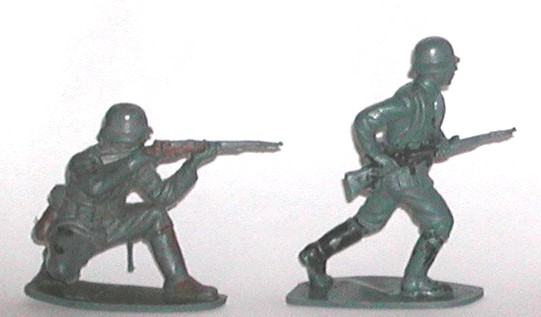
The Infantry Combat Group and the German Infantry were different. These were miniature soldiers in combat poses. The Infantry Combat Group were molded in a medium green drab. Their equipment was along the lines of British troops, along with the late-war Tortoise Shell helmet. At that size, they could pass for other Allied troops. Cast in a blue-grey, the Germans wore the standard helmet and uniform that were issued from 1938 onward to 1944. Both sets had stretcher bearer medic teams. The Germans also had a peculiar antitank gun very loosely based on the PAK 42 "Squeeze gun". I doubt the sculptors checked the TO&E for either army. Conspicuously missing were the light machine guns that were part of every infantry squad during World War II.
There was not much else out there. Authenticast had made some 20mm scale figures of American, German and Soviet infantry. The sets included one or two advancing riflemen, an advancing submachine gunner, prone and kneeling riflemen, and a man with an antitank weapon. In this case, it was a Panzerfaust for the Germans and a bazooka for Americans. Each set also had one-piece castings of a two-man machine gun team and a 37mm antitank gun with two crewmen. However, these were not well known. Few shops carried them. Airfix was the first most of us saw of small-scale soldiers.
The combination of Airfix soldiers and ROCO tanks enthralled budding young hobbyists. The tanks had excellent detail in a small size, and the soldiers looked good. Price also had its due. At 50 cents for a box of Airfix soldiers and a quarter for a Roco Minitank, a lad could have a platoon of infantry and two supporting armored vehicles. Additionally, those early ROCO tanks came with a pair of decals: white stars for US, red stars for commies and panzer crosses for the Germans.
AHM billed the Airfix soldiers as Minimen to accompany the Minitanks. The small boxes of soldiers had cellophane windows though which you could see the figures. On back of each box was a list of all the poses and figures enclosed. Boxes were brightly colored with drawings of their contents.
The original owner painted his to match the box art
|
And if you look at the picture on the Infantry Combat Troops, you can see that the artist was inspired by Herald’s Khaki Infantry. Two of the men are carrying SLR rifles and charging like the Herald figure, which is not replicated in the Airfix set.
The fun started when the box was opened. Out came sprues of soldiers. Each had to be detached with a little twist and turn. Each new pose was interesting. Soon there was a small pile of diminutive army men just waiting for their first battle.
The German seemed exotic to us. They had those odd grenades and other weird equipment. Most of us had only seen German troops in the movies. Handling toy German soldiers up close brought us into contact with their unique uniforms and equipment.
In no time, our toy soldiers were coupled with the toy tanks. Our tabletop battles began. We could have a complete battle on half of a kitchen table with the tiny figures. And what fun they were. Both sets had the classic posed: grenade guy, kneeling shooter, standing shooter, crawly guy, the charging guy. The Infantry Combat Group had one pose for a bayonet charge. None of the German weapon sported bayonets, so they better not run out of ammo!
We could put soldiers in back of little HO size half tracks and army trucks. Some could hitch a ride on back of a tank.
Of course, it got even better.
Our local hobby shop made a diorama using the tanks and soldiers. They also used a set of small European buildings, known later as "Village in a Bag." There were four cottages and a small church. Using a soldering iron, they had some "battle damage" to the houses. A combination of model railroad scenery and other items made a battle in a small town, complete with a creek running across it and bridges. The diorama maker had painted the faces, belts and weapons of the soldiers. Little boys thought it was amazing. I am sure that diorama, placed in the shop window, sold many a toy tank and box of Airfix soldiers.
In time, Airfix and Roco expanded their lines. ROCO added various tanks and vehicles, both modern (at the time) and World War II vintage. Airfix made more Minimen. Cowboys and Indians came next, cast in a russet color. In the following years they produced Civil War troops, British 8the Army, the Afrika Korps, French Foreign Legion and US Marines. Each new set was a welcome addition. We eventually had Japanese troops, paratroopers, Russians and commandos to supplement our tanks. There were also historic sets such as Romans, knights (Sheriff of Nottingham), ancient Britons and Medieval peasants (Merry Men) For some reason, the Revolutionary War guys were not that popular. Nor were the Napoleonics. The World War I sets went over well, however. I wonder how much Snoopy and the Red Baron had to do with that.
And how many of us busily built and painted Airfix’s 1/72 Sopwith Camel and Fokker Dr 1 Triplane? More than a few!
Four Airfix Second Version US Marines
|
Later, we started building the Airfix 1/76 military models. There were a handful of them before 1970, after which more vehicles were added to the list. The Airfix kits were nice enough. They seemed to dwarf ROCO and the other brand of pre-built tank, Roskopf. Nonetheless, we loved them all.
Airfix updated several of its older sets. I first saw these after finishing my time in the Army. The company re-sculpted its German Infantry, British Infantry, (Infantry Combat Group), US Marines, 8th Army, Foreign Legion and Afrika Korps. They were a little bigger and the poses were more realistic with better details. The larger size made them less compatible with ROCO. Meanwhile, other companies were competing. Matchbox had a series of World War II soldiers. An Italian company called Atlantic arrived with a variety of ancient warriors, Wild West figures and World War II troops. Fujimi and Hasegawa made hard plastic kits of World War II troops. Later, Esci entered the market. For most of us, Airfix was the standard by which all others were judged.
A Few of the Airfix Second Version British Infantry
|
Come the 1980s my circumstances and responsibilities changed, and I had to put hobbies aside for a time. My collections got lost later in that decade. When I again had time and space for hobbies, it was the mid 1990s. New makers were adding to the realm of small figures. Today, the variety is overwhelming. Many are from Russia and the Ukraine. The variety of armies and eras and troop types is astounding.
For all the variety and quality, those of us who were there when it began have a fondness for those two original sets of Airfix army men. The Infantry Combat Group and German infantry were our first and the ones that got the ball rolling.
Five Airfix First Version US Marines
|
******
Airfix might not have gotten all the details correct in some of their sets, but the animation of poses and assortment of figures made most sets a charm. They made a hard standard to match. In my opinion, Matchbox came close but was not quite as good. Esci ran hot and cold. Some sets were great and others were rather blase. Atlantic had its ups and downs, too. I have seen some of the current sets from various makers in recent years and it is quite amazing. Quality and variety are truly astounding. Even then, a set of Airfix soldiers usually costs a few dollars less than the others.
I think that I would like to use troops closer in scale to ROCO. Most of the 1/72 are too large. Granted, I have lost touch with 1/72 figures because I spend most hobby time making the 1/32 and 1/30 figures I hand cast.
**************
For those interested in games with HO size soldiers and ROCO tanks, here are some rules you might want to try:
My game "Tankplank" was inspired by that diorama in the old hobby shop. It is an armored and infantry battle in a town. You can get Tankplank and Tankplank Advanced Rules here:
Battle by Charles Grant was one of the early sets of World War II games with HO miniatures. You can download a copy of the book when it ran in serial form in Meccanno Magazine from this page here:
We have several small games that derive from Charles Grant’s system. They are World War II game "Hans und Panzer," a version of Hans und Panzer for the war in North Africa, and a Cold War version called "Krunch a Commie." they can also be found on this page:
Phil Barker’s ruels for infantry and infantry armor games can be found here, as well as Ancient, Medieval and other rules.:
Thursday, February 25, 2016
Of ROCO Minitanks and Hobby Shops
The first time I entered a hobby shop, I was five or six years old. We were there because some older boys on the block had new toy soldiers. They were tiny. My mother had asked where they got them, and they told her about the hobby shop.
The hobby shop was a little storefront on Central Avenue. It was a small shop. There were display windows on either side and a door inside at the center. The windows displayed various models and trains and those tiny soldiers.
We entered a typical store of the time. There was a counter on one side with shelves behind it and some display items. The other side was a wall of wooden shelves with models and trains.
In one of the glass counters was a small display. I think it was white, or maybe a light gray or pale blue. The display was terraced, like steps. On each step were three or four tiny vehicles. They were a very dark color. Most were tiny tanks. Beside the display were boxes of the tiny soldiers.
To buy a tank, you had to tell the counter man which one you wanted by saying its number. He would look through stacks of gray boxes on shelves in the back counter. Each box had six or more tiny vehicles, each wrapped in a small plastic bag. Packed with each was decals: white stars for American vehicles, red stars for Soviets and Panzer Crosses for German tanks. The tanks were 25 cents apiece.
There were two kinds of soldiers in cardboard boxes with cellophane windows., They had a picture of soldiers on the front, and a list of the figures on the back. Only two kinds of soldiers were available. The green drab Infantry Combat Group looked like Allied soldiers. Blue-gray German Infantry had figures of World War II German troops. Each had 48 pieces. For a dollar, you could buy two tanks and a platoon of infantry.
There were other figures for model railroaders by the same company. I remember Farm Animals and Civilian figures in "HO / OO" scale. There was also a marching band set and British guardsmen.
At the time, ROCO only made a few different vehicles. I remember the US M47 and M48 Patton tanks, a US M4A1 Sherman, at least two different Panzer IVs, a German Panzer V "Panther", a Soviet JSIII "Stalin" tank, a 2 ½ ton truck and some other items.
We did not know much about tanks then, except for what we saw in movies, read in comics, or heard from older relatives who were veterans. Our play wars included a few tanks that were from a later era. We did not care. For little boys, close enough is good enough.
Of course, we could afford the little Roco tanks and Airfix soldiers. I remember one year when Halloween fell on a Saturday. My friends and I were out all day trick or treating. Along with candy and apples, some folks gave money. W e gathered nickels and dimes and pennies. One old woman even gave out quarters. That money was enough to buy some tanks at the hobby shop, which is just what we did. Then we returned to trick or treating to get more loot.
ROCO and Airfix continued to add new sets over the years. They all ended up at the little hobby shop. I remember the Airfix 8th Army, Afrika Korps, US Marines, Cowboys, Civil War guys, Indians and French Foreign Legion. Then came new sets with more detail, such as the Japanese Infantry, Arabs, Robin Hood, Romans and Ancient Britons. ROCO added more modern tanks and upgraded a few others, as well as expanding their World War II lines. In our youthful enthusiasm, we had toy-tank arms races where both sides had too many King Tigers and nothing lighter than a Sherman.
A couple of things changed the way we enjoyed our mini-tanks and min-men. One was a book titled War Games: Battles and Manoeuvres with Model Soldiers by Donald Featherstone. The book showed us a better way to play games with our tanks and troops.( A later book by Featherstone used specifications made to fit Airfix’s inventory of 1/76mm kits for a more advanced type of game. We loved it.)
Another change came over a decade later. Summer of 1972 was spent at the Jersey Shore. I made some friends and found a hobby shop: Air and Armor Hobbies in Belmar, NJ. We had a lot of fun, played our wargames and built models. At Continental Hobbies out by Freehold, I was introduced to the Roskopf mini-tanks. Of course, soldiers were the least of my concerns at the time. Like many youths my age, I would drop everything if a female entered the picture. (She was a skinny Irish chick and we had a lot of fun.) And so it was until mid-Autumn of that year, when I went into the Army....
My collection of tiny tanks and soldiers and other wargame figures were lost in the mid-1980s. A couple of disastrous moves followed by unexpected circumstances upset everything. I had little time for hobbies after that. Many other things needed my full attention. One needs a stable place to work with miniature hobbies. It took another ten years before I got back into them.
I have to admit a disappointment in miniature hobbies these days. There is little incentive for young people to get involved in them. Model kits are very expensive. So are trains. The little tanks sold by Herpa, many of which are reissued Roco models, are very expensive. While the Airfix soldiers are priced reasonably for these times, the tanks and other vehicles are not.
ROCO had competition. Eldon, UPC, Aurora and Marusan made kits that were pretty much knockoffs of Roco vehicles. They were all affordable. The same went for the Roskopf tanks. They were all priced fairly for the time. When I see the price of Herpa kits, I balk, Sure, some are updated and have extra detail. That tooling might have been expensive. However that may be, how does an item that went for 29 cents in 1966 sell for over $20 in 2016? And how are we going to attract young people to the hobby when a single piece costs more than one of their video games?
We need to bring back those competing kits!
One of the things this hobby gives is the satisfaction of doing it oneself. I remember how I felt the first time I did a full paint job and decals on a ROCO tank. That is just one of the satisfactions this hobby has. There was the fun of learning about the real vehicles and how they were used. More fun came by painting soldiers and arranging miniature units. There were also dioramas and little battlefields we made, using the old "Village in a Bag" houses. We learned to paint and assemble small things, and to use our creativity with tangible results.
The fellows running the old hobby shops were more than merchants. They knew their products and how to work with them. In our local shop, the owners showed us how to camo-paint our ROCO tanks and told us what paint set to buy. (Testor’s Military Flats). The same guys could tell you how to set up switches on an HO railroad, what track you needed to expand an HO slot car set, and what tricks to use building model kits. I can think of a few other shops offhand where the folks behind the counter could offer expert advice on using the shop’s products. Sadly, all of them are long gone.
I believe that one day, people will realize what they are missing and will again seek activities that require making something. At least, I hope so. The virtual world and video games are ethereal and intangible. People may again seek to make something tangible, They will want that which has physical reality. Likewise, I hope they regain the satisfaction of making something.. For us who know the pleasure of the job well done, the benefits are obvious. Perhaps one day young people will rediscover those benefits for themselves.
****
Most hobby shops were fun, but there were always an odd few where the owners were less than congenial. We called them "Hobby grumps" and "Hobby grouches". Those surly individuals acted as if customers were at worst a nuisance, at best an occupational hazard. Most of them also thought they were the best hobby dealers on Earth and deserved total customer loyalty. As soon as a competing shop opened close enough to them, their customers headed to the new place. Should any ever stop back in the grouch’s shop again, they would hear a derisive remark about being a disloyal customer or some such rubbish.
The hobby grumps were especially unfriendly to younger hobbyists. Instead of seeing children as the future of the hobby, they were rude. By the time those kids became older and had more to spend on hobbies, they were already someone else’s customers.
Fortunately for me, the folks who ran the hobby shop in my neighborhood were friendly to all of their customers. That inspired many to invest more interest in hobbies. Most shops were the province of good-natured fellows who were more than happy to share their expertise. That personal insight is something that cannot be gotten on the Internet. On the other hand, the grumps were a rare hazard in an otherwise pleasant field.
Labels:
Airfix,
armor,
combat group,
EKO,
German,
hobby,
hobby shop,
infantry,
king tiger,
minitanks,
model kits,
panzer,
ROCO,
Roskopf,
soldiers,
tanks,
toys
Subscribe to:
Posts (Atom)